
The first memorial to George Washington
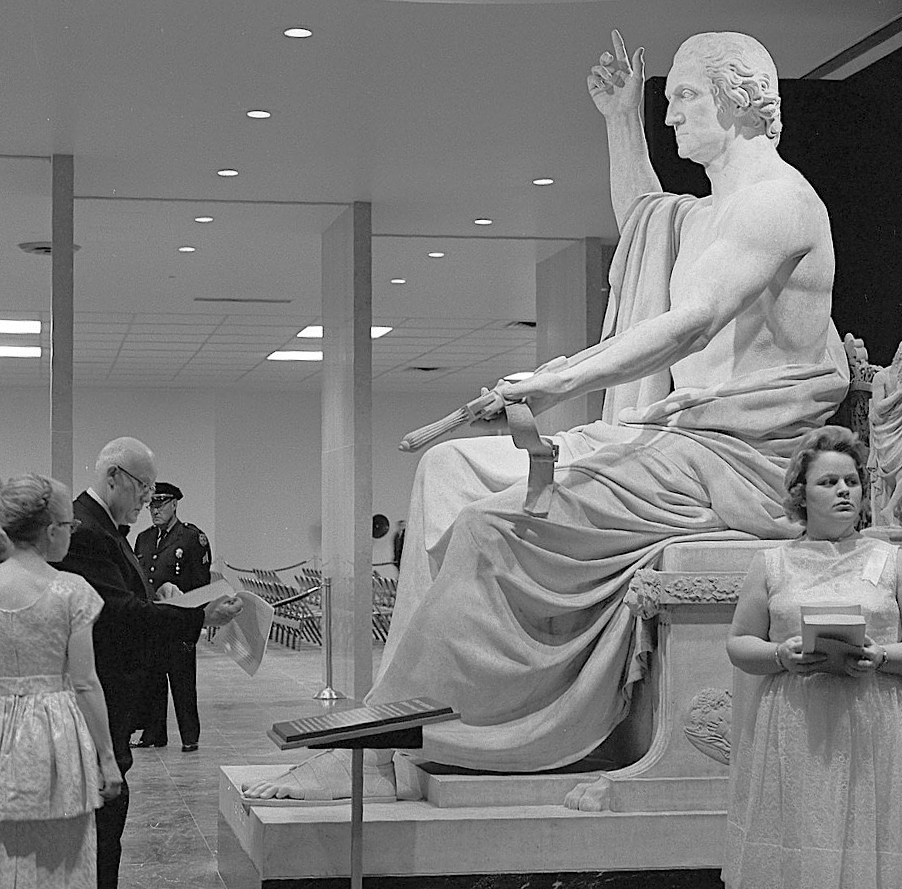
On July 14, 1832, the U.S. Congress commissioned sculptor Horatio Greenough to create a statue of Washington in honor of the 100th anniversary of Washington’s birth.
The statue was intended for the rotunda of the United States Capitol. However, when the marble statue arrived in D.C. reaction was decidedly mixed, and not in a good way. Some found the half-naked statue to be offensive, others found it funny.
At Greenough’s suggestion, the statue was moved out of the Capitol building. The statue spent a good part of the next 60 years exposed to the elements. Finally, in 1908, the statue was transferred to the Smithsonian Castle in 1908. In 1964 the statue was moved from the Castle to the brand new National Museum of American History where it remains on view.
Horatio Greenough’s 12-ton marble statue of President George Washington was executed in the neo-classical style, inspired by the classic statuary of ancient Greece, the home of the world’s first democracy. The conception of the seated figure derives from a famous lost statue, the “Olympian Zeus” by the ancient Greek sculptor Phidias. Additional carvings on the sides of Greenough’s work depict the Greek god Apollo and an infant Hercules. Further designs feature small flanking figures of an American Indian and Christopher Columbus, representing the New and Old Worlds. The most important symbol is the sword in Washington’s outstretched hand, which represents how he relinquished his military power to the people.
Washington’s features copy the life-portrait bust by the French sculptor Jean Antoine Houdon. Despite this accuracy, Greenough understood that his sculpture did not fit the impression most Americans had of Washington.